
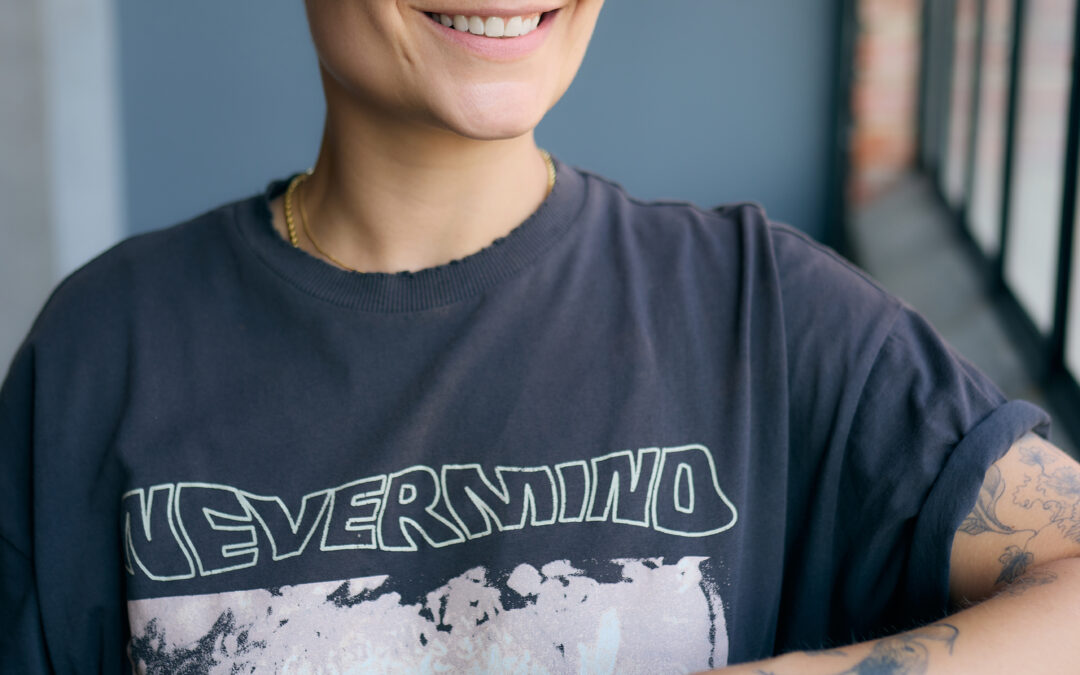
Gillian Forth’s story with neurodiversity began when she was seventeen, sitting in a psychologist’s office and receiving a diagnosis that felt vague and strangely disconnected from her lived reality. She was told she had a non-specified non-verbal learning disability. The feedback focused on what she supposedly could not do, and offered accommodations that never really resonated with her. She remembers being warned that university would likely be a struggle, and yet that prediction turned out to be far from the truth.
She went on to study political science and history in university, excelling academically and enjoying the experience. Reading and writing had always felt natural, thus not proving to be a problem in her studies. As such, the diagnosis offered little clarity and held no meaningful role in how she saw herself. In her words, it “didn’t seem to reflect my reality very well.”
A New Understanding Emerges
Years later, Gillian found herself in a very different place. After more than a decade in the nonprofit sector, she joined an organization dedicated to supporting neurodivergent individuals in employment. Her role involved coaching autistic and otherwise neurodivergent job seekers, as well as facilitating training for workplaces on neuroinclusion.
As she immersed herself in this community, something unexpected happened. She began to recognize aspects of herself reflected in the people she was supporting. She described it simply and clearly:
“As I gained a greater understanding of different neurodivergent identities, it really opened my eyes and resonated deeply.”
The more she learned, the more she realized that her original diagnosis had overlooked something essential.
In her adulthood, Gillian came to understand herself as a late-realized autistic woman. This self-discovery felt more accurate and finally provided language that matched her experiences. She also recognized how years of masking, especially as a woman, were effective in making her autism less visible to others and even to herself. This late understanding became a significant part of her identity and offered new clarity about her strengths, challenges, and needs.
Learning Through Work
Gillian’s early jobs were grounded in care, community, and women-led spaces. Her first role was in her mother’s animal hospital and veterinary clinic, where she spent about ten years, off and on, working part time with minimal hours. During that time, she cleaned kennels, walked dogs, and helped support the technicians and doctors. Working alongside her sister and a team of women provided a safe, flexible environment that shaped her early confidence.
She later worked as a lifeguard, swim instructor, bartender, and server, gaining experience in fast-paced and highly social environments. She enjoyed much of this work, although some social dynamics were difficult at times.
Gillian’s first major career role in the nonprofit sector brought her into classrooms across Toronto to facilitate workshops on social justice issues. She loved working with children and teens, as well as being part of a diverse team, yet this was also one of the first places where deeper challenges began to emerge. Navigating social norms, implicit hierarchy, understanding unspoken expectations, and managing black-and-white thinking in complex social justice spaces often led to confusion and frustration. Despite the job experience being extremely rewarding, it led to a period of burnout.
“I felt like there was a lack of really tangible support, and it was also financially unsupportive.”
Moral Injury in Mission-Driven Work
As she continued through various nonprofit roles, Gillian began to notice a painful disconnect. Organizations that publicly championed values of equity and justice sometimes made internal decisions that contradicted those same values. Funding constraints, watered-down advocacy, and decisions rooted in organizational survival rather than community wellbeing left her feeling misaligned and disheartened.
She described this as “looking behind the curtain” and seeing contradictions she could not reconcile. These experiences accumulated over the years and often led to moral injury, burnout, and the feeling that she could not change systems that were not ready to be changed.
Still, there were bright spots. Her most recent full-time role consisted of supportive management and a genuinely neuro-affirming environment. She often says that good leadership can make or break a workplace experience.
“I think even when we’re in environments where there are challenges within the larger organization, our managers can make up for them in many ways and supersede those types of challenges,” she described. “And, conversely, in great organizations with great roles that people love, managers who are unsupportive, who create barriers, or don’t recognize barriers that someone might be experiencing, can turn what would be an otherwise good role into an incredibly negative experience.”
Her manager in that role made all the difference by being open to listening, collaborating, and creating space for her to show up authentically.
Stepping Into Self-Employment
Eventually, the need for alignment pushed Gillian toward self-employment. Her practice, The Low Achiever, is a space where she coaches neurodivergent individuals and supports organizations with neuroinclusive practices. She also does ADHD and autism coaching by contract with two companies, one of which was where she held her last full-time role.
What feels most empowering about self-employment is the autonomy it affords her. She cherishes being able to work according to her own rhythm and values, without needing to justify her beliefs or how she structures her time. Her work is deeply grounded in disability justice, intersectionality, and an understanding of how ableism, colonialism, capitalism, and white supremacy shape the experiences of disabled and neurodivergent communities, including how these systems are embedded in Canadian culture.
Gillian acknowledges that the space she works in is inherently political and she carries these commitments into every part of her practice. For example, not everyone who is neurodivergent chooses to identify as disabled, and Gillian emphasizes that this is completely valid. At the same time, she notes that the reasons behind this choice are often complex, shaped by stigma, ableism, and the deep roots these biases have in systems like white supremacy, capitalism, and colonialism. Understanding these forces is central to her own grounding in disability justice.
“I think it’s so important to be constantly learning and growing in that space [disability justice], particularly as a white woman,” she explained. “I don’t think that we can effectively work in this space and make the differences and changes that we want to see without acknowledging those roots.”
She goes on to highlight that without recognizing the impact that race has on how disability is socially constructed, we miss crucial context. It is essential to include the perspectives and lived experiences of marginalized communities, including trans people and BIPOC communities, and to intentionally bring those insights into our work.
Creating Rhythm, Rest, and Community
Self-employment brings its own challenges. Since she works alone at the moment, it can be isolating, and virtual work makes connecting harder. Gillian intentionally seeks out community through professional networks, conferences, and live conversations, even when her energy fluctuates.
Her neurodivergence also shapes the way she structures her work. She pushes back against the belief that we must always be productive, responsible, and constantly doing more. To model this shift, she and her partner created their “Sunday Rot” ritual, a weekly day of complete rest. This intentional downtime helps her recover her energy, prevent burnout, and stay grounded.
Many of the neurodivergent clients Gillian works with share her values but often struggle to embrace them fully at first. They may long for rest without guilt or want to detach their self-worth from productivity, but internalized ableism makes this difficult. Supporting clients in unlearning these beliefs and fostering self-compassion is a core part of her coaching practice. She finds that her openness naturally attracts clients who are ready to challenge these narratives.
Asking for Help and Building Self-Efficacy
A major turning point for Gillian was learning, especially during university, to ask for help and let go of the idea that everyone else was coping better than she was. She learned to focus on her own needs and seek support without feeling guilty. Through intentional reflection, coaching, and mindset work, she built strong self-efficacy: the belief that she can do hard things and that she doesn’t have to do them alone. Practical tools like exercise, medication, sleep, and nutrition are also essential supports in her life.
The Roots of Ableism
Gillian wishes more leaders recognized that neurodivergence is different, not less. Ableist assumptions that disabled people are less capable remain pervasive, including beliefs that hiring disabled people means having to lower expectations. She argues instead for workplaces that value all forms of contribution, adapt to human variability, and recognize that everyone benefits from flexibility and understanding. Truly inclusive cultures acknowledge the inherent worth of disabled people whether or not their contributions are measured through traditional economic lenses.
She believes that modern misconceptions about disability and neurodivergence are deeply rooted in colonialism, capitalism, and white supremacy. These systems shaped the social construct of disability, much like they shaped the social construct of race. Many of the stigmas we treat as second nature are not ancient or universal, but relatively recent inventions shaped by Western colonial histories. Without understanding these origins, she argues, change remains superficial instead of transformative.
Gillian explained that conversations about inclusion often stay on the surface. As she put it:
“The tip of the iceberg is awareness of disability and creating different kinds of social support or safety nets. When we go deeper under the surface of that iceberg, we’re asking questions such as what makes something an accommodation? Who decides what the default workplace is?”
What a Neuroaffirming Workplace Looks Like
For Gillian, a truly neuroaffirming workplace begins with psychological safety. Employees should feel free to express ideas, make suggestions, offer criticism, and ask for support from those who may hold more power, all without fear of retaliation. Beyond tolerance, workplaces should actively embrace conflicting needs and adapt continuously as teams evolve. A neuroaffirming environment is not a fixed endpoint but an ongoing collaborative process rooted in trust, respect, and transparency.
“It’s a process. It’s something that you create and co-create on a consistent basis. Because people’s needs evolve, people’s needs change, and they will conflict with each other.”
Honoring the Voices That Shape Her Work
In closing, Gillian highlighted the essential role of autistic content creators, disability advocates, and particularly the lived experiences of Black, queer, and trans disabled leaders in shaping her understanding of disability justice. She credits these creators for the insight, community, and labor that inform her work.
She also stresses that anyone working in disability spaces who is not listening to or learning from marginalized communities, particularly BIPOC and queer disabled creators, is overlooking a crucial part of the conversation. Intersectional perspectives, she says, are not optional; they are foundational.
👉 To learn more about her work, or for coaching and workshop inquiries, you can contact Gillian through her practice The Low Achiever.