
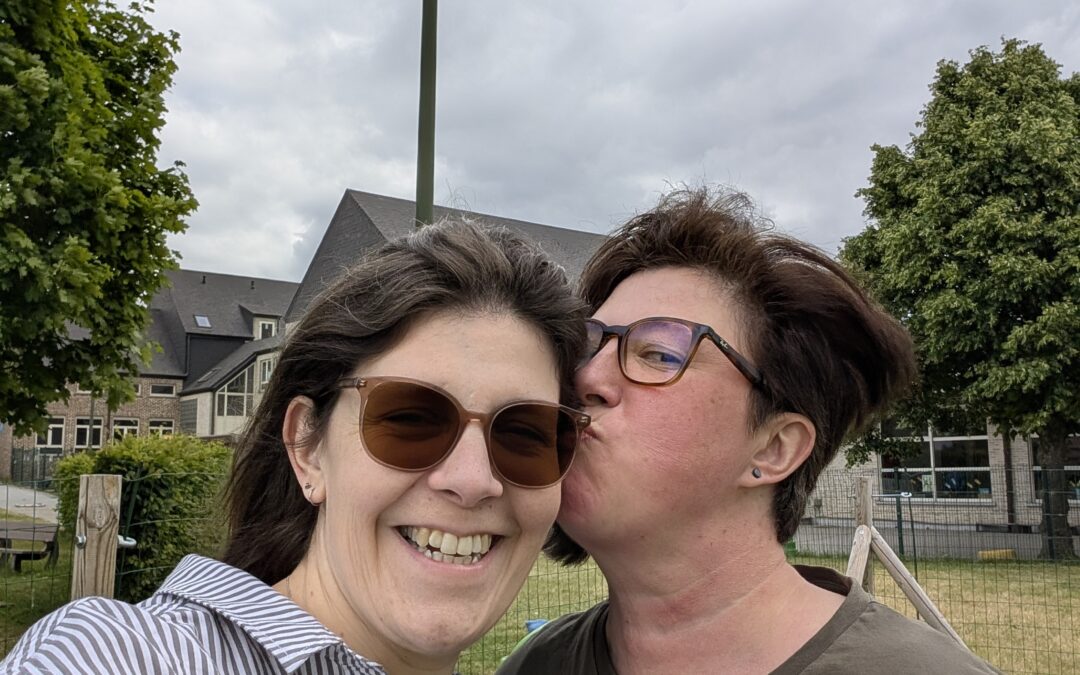
It wasn’t until the age of 40 that Kelly Crabbé, a DevOps Engineer at Loop Earplugs, finally received the diagnoses that made sense of a lifetime of internal contradictions: Autism Level 1 and ADHD, combined type. Before that, there had been a revolving door of labels such as borderline personality disorder, generalized anxiety disorder, even “hysteria.” That last one, she recalled with a laugh, was “really Freudian of that doctor.”
Clarity came when a boss at a former company gently suggested she might have ADHD. At first, Kelly rejected the idea.
“ADHD is for boys,” she thought. Her only reference point had been a classmate who couldn’t sit still. “I don’t do that,” she insisted. But her boss pointed out that she did, just not in the same way. “You do that when you’re talking. You’re very chaotic, you don’t focus on a single thing, and you switch tasks a lot,” he told her.
His words led her to seek a formal assessment. The diagnosis was confirmed, and while that boss had been supportive, her new manager responded very differently. When she disclosed her diagnosis, she was given a hard time and was eventually fired.
From Safety to Shutdown
Kelly had once felt supported at work. But after a management reshuffle, she was placed on a team where she no longer felt psychologically safe. The new environment was overstimulating, rigid, and filled with noise.
“I can’t filter sounds due to my ear,” explained Kelly, who is deaf in one ear. “I can’t filter sounds due to all the other things,” she added, referring to the sensory sensitivities that come with being neurodivergent.
She asked to wear noise-canceling headphones and was told no. Soon, her ability to function began to break down.
“I lost the ability to perform coherent sentences,” she recalled.
Her doctor diagnosed her with burnout. She took medical leave and was sent a final warning by HR the very next day.
Thriving at Loop: A Workplace That Listens
Today, Kelly works at Loop Earplugs, a company that doesn’t just sell quiet, they champion it. Their motto, “Live life at your volume,” feels personal. She works alongside teammates who are also neurodivergent, including a manager with ADHD.
“They’re a little bit crazy,” she joked affectionately, “but it’s fun.”
There are support dogs, silent booths, fidget toys, and a workplace budget you can use to buy noise-canceling headphones. One of the founders even said in a team meeting, “Swing by for a chat or a hug if you’re up for it.” When she did just that and later worried she’d overstepped, he messaged her: “Do not change how you are, because it’s just wonderful.”
Work With Heart
At Loop, expectations are high, but so is empathy.
“There’s a lot of chaos, and it does get to me,” Kelly admitted, “but they hired me because I can see patterns and data flows.”
For Kelly, data is visual and intuitive. She sees it as glowing, semi-translucent threads flowing through systems and websites.
“If I can close my eyes and see how the data transforms, then I understand the system. If I can’t, then I’m screwed.”
That pattern-seeking mindset is her superpower, and at Loop, differences and accommodations are respected.
“If I have a very bad day, I can just say, ‘Look, I’m going to log off. And I’ll catch up a few hours later.'”
Living Without a Mask
Today, Kelly is proudly open about being neurodivergent, queer, and deaf in one ear; not out of obligation, but because she hopes her story will help others feel less alone.
“If it helps one person, it was all worth it.”
She no longer pushes herself past her limits.
“If my manager feels he might have bad news for me, he’ll tell it to me and then we’ll stop the call right there. Then the next day, we retake the call when I’m calmed down and we actually can constructively talk about it. So he just gives me processing time.”
Instead of masking, she listens to her body. She walks her dog when overwhelmed, uses music to regulate her emotions, and stims freely in public.
“I don’t care what people think anymore.”
Rewriting the Narrative
Self-acceptance changed everything. Where she once turned to self-injury to cope, she now turns to understanding.
“Since I’ve been diagnosed, I also understand myself a lot better. I haven’t done self-harm since then. Maybe just once. So I’m doing a lot better in dealing with my explosive moments.”
What made the difference wasn’t changing who she was. It was finding a place where she could be fully seen.
“If my heart is in something, I will give you my all. So that means that you will get me hot and fired up, and I will do what I can to actually meet the deadline, but just allow me to be me.”
A Message for Others Like Her
“If I think back on my previous jobs, my life would have looked a lot different had I worked for people who were more understanding and supportive,” Kelly said.
Too often, when she struggled and asked for support, it was interpreted as unprofessionalism, not an unmet need.
Her message to others, especially women whose neurodivergence was missed or misdiagnosed, is powerful:
“We’re not broken. We’re not hysterical. We mask because it is expected of us, and it’s fucking tiring. We are worthy. Period. We are enough.”