
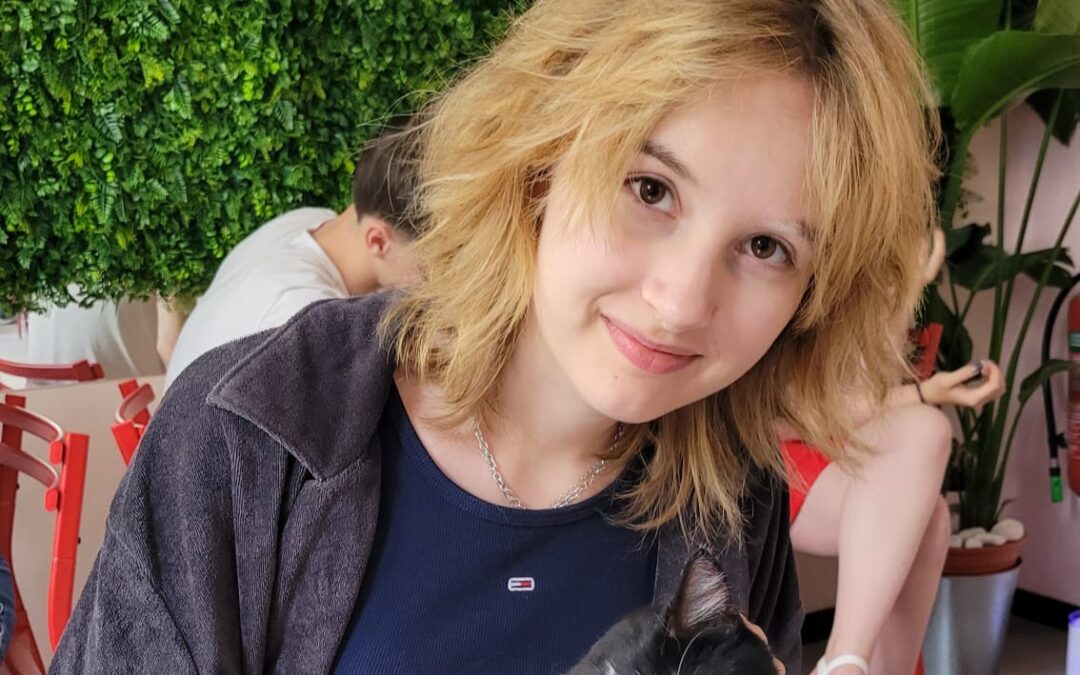
Meet Louise Leroy, an IT Consultant at Passwerk, whose story exemplifies neurodiversity workplace success. When Louise was diagnosed with autism in 2018, it brought clarity but not immediate answers. At the time, she was still navigating short-term student jobs, often lasting only a few days. The pattern repeated itself: she’d begin a role, feel overwhelmed, and either resign or be asked to leave.
“It wasn’t very easy,” she recalls. “There were always too many people, too much noise, too many things happening at once. It was just… too much for me.”
Her early work experiences, whether in a supermarket or at a theme park’s restaurant, rarely felt manageable.
“When I enter a group of people I don’t know, it can be really difficult. For example, my job at the amusement park was in food service, so I also had to talk to people, serve them. That was hard too, it was a bit too much. I had just received my diagnosis and didn’t really know what I could handle or what was too much for me. That job at the amusement park was a lot all at once. I wasn’t prepared enough, I didn’t really know what to expect, and it was just a bit too much.”
That sense of overload, of being misunderstood and unsupported, led to a cycle of burnout and self-doubt.
“I had no confidence in myself.”
A Place that was Just Right
Everything began to shift when Louise joined Passwerk, a Belgian company that hires autistic professionals and supports them in finding long-term, meaningful work. At Passwerk, each consultant is paired with a job coach who acts as a bridge between the employee and their work environment, helping to communicate needs and advocate for accommodations.
For Louise, this model was transformative.
“I have already been working there for four years,” she says with quiet pride. “It’s a big change from the few days I used to work in my previous jobs. If I encounter a difficulty, I can always communicate it to my job coach. And she will do everything to try to help me.”
She’s currently working on IT projects, often from home, where she can focus in a calm, predictable environment.
“I sit at a desk where I can also sometimes work from home. I don’t have to work with clients. So, for me, it’s more comfortable to do things with my computer at home.”
The combination of structure, support, and trust has given Louise something she’d rarely felt before in the workplace: confidence, a crucial element in achieving workplace success for neurodivergent individuals.
“It’s mainly the fact that I was able to find a job that helped me regain some confidence in myself. Because before, I had no confidence at all in myself with the other jobs that didn’t go well.”
Beyond the logistics, it’s the openness around neurodiversity that makes Passwerk special.
“I feel very comfortable talking about issues related to my diagnosis and accommodations. So, I feel good at my job right now.”
Creating Space for Difference
Still, Louise knows that many neurodivergent people aren’t so lucky when it comes to achieving neurodiversity workplace success. When asked what she wishes more employers understood, she speaks thoughtfully.
“It’s important to know that for many autistic people, communication and social interactions can be difficult. That doesn’t mean we’re not trying. For me, I do my best to work well, but I might not always know how to express what I need.”
She hopes workplaces become more patient, more open to listening without judgment.
“Sometimes people expect you to act a certain way, to be very social, to talk a lot. But not everyone is like that. And that should be okay.”
Finding Her Place
Louise’s story is one of quiet determination. It shows that with the right environment that values individual needs and strengths, neurodiversity workplace success is possible, enabling neurodivergent employees to not only succeed but thrive.
As she reflects on how far she’s come, Louise is clear:
“I found a job that helped me regain my confidence. Before this, I didn’t believe in myself.”